AI in MBA: Why Future Managers Need AI
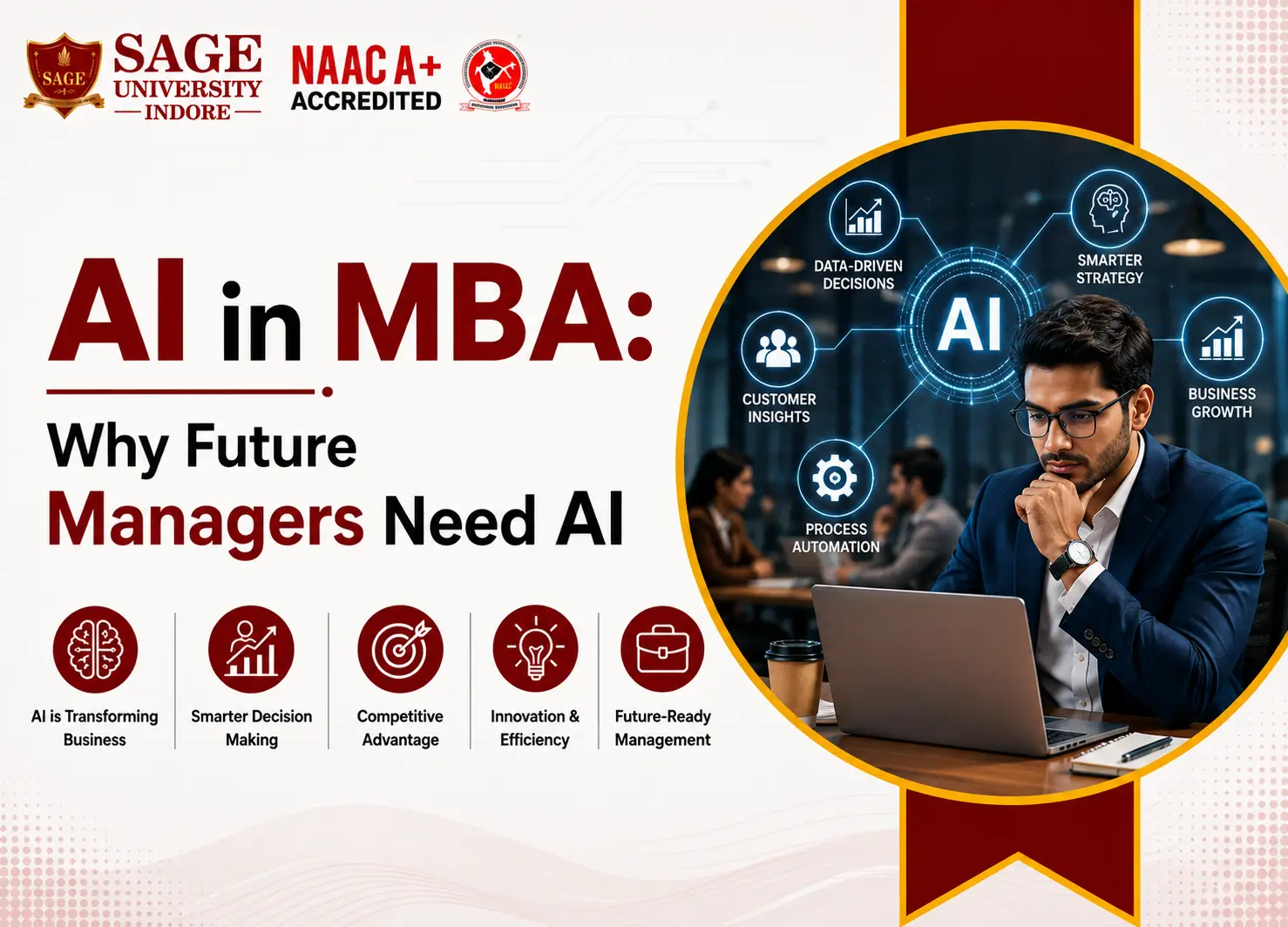
Artificial Intelligence (AI) is no longer limited to technology companies or computer science departments. It is becoming an important part of modern business, management and decision-making. Businesses are using AI to understand customer behaviour, forecast demand, analyse financial data, improve operations, support employees and make faster strategic decisions.
For MBA students, learning Artificial Intelligence does not necessarily mean becoming a programmer or AI engineer. Instead, it means understanding how AI works, where it can be applied in business and how managers can use AI responsibly to solve real-world business problems.
An MBA combined with AI skills can help future managers understand both business strategy and emerging technology. This combination can be valuable for professionals working in marketing, finance, operations, human resources, consulting, business analytics and digital transformation.
Table of Contents
- What is AI in an MBA?
- Why Artificial Intelligence Matters for Future Managers
- How AI is Transforming Different Business Functions
- Top AI Skills Every MBA Student Should Learn
- Best AI Tools for MBA Students
- Benefits of Learning AI During an MBA
- Industries Hiring AI-MBA Graduates
- Career Opportunities After an MBA with AI Skills
- Challenges of AI in Business Management
- Future of MBA in the AI Era
- Expert Tips for MBA Students
- Frequently Asked Questions
1. What is AI in an MBA?
AI in an MBA refers to understanding and applying Artificial Intelligence in areas such as business management, strategy, analytics and decision-making. It connects traditional management knowledge with technologies that can analyse large amounts of information, identify patterns, generate insights and automate repetitive activities.
An MBA student does not need to become an AI engineer to benefit from Artificial Intelligence. Instead, students can learn how AI can be applied to marketing, finance, operations, human resources, business analytics and strategic planning.
For students interested in formally combining management education with Artificial Intelligence, an MBA in Artificial Intelligence in Management can provide an opportunity to explore the relationship between business management, AI and emerging technologies.
For example, an MBA student specialising in marketing can learn how AI supports customer segmentation, campaign analysis and personalised communication. A finance student can explore AI-assisted forecasting, risk analysis and fraud detection. Similarly, an operations student can understand how predictive analytics can support demand forecasting and inventory management.
Students who want to start developing AI and business skills at the undergraduate level can also explore a BBA in Artificial Intelligence, which combines business education with areas such as AI, data analytics and digital business applications.
The goal is to understand how AI can solve business problems, rather than simply learning how to use individual AI tools.
This combination of management knowledge and AI awareness can also help future managers communicate more effectively with technology teams while keeping business objectives, customer needs and organisational goals in focus.
2. Why Artificial Intelligence Matters for Future Managers
Modern managers are expected to make decisions quickly while working with increasingly large amounts of business data. Artificial Intelligence can help managers identify patterns, generate insights and support decision-making.
For example, a marketing manager can use AI-supported analytics to understand customer behaviour and identify campaign trends. An operations manager can use predictive analytics to identify potential supply-chain issues. A finance manager can use AI-assisted analysis to examine financial patterns and support forecasting.
However, the value of AI for managers is not simply about knowing which AI tool to use.
Future managers need to understand:
- When AI should be used
- What business problem AI can solve
- How to ask effective questions
- How to evaluate AI-generated information
- What data is required
- What risks and limitations need to be considered
- When human judgement should override an AI recommendation
This is why AI education can be valuable within an MBA programme. It can help students develop the ability to connect technology with business strategy and make informed decisions in technology-driven workplaces.
3. How AI is Transforming Different Business Functions
Artificial Intelligence is influencing almost every major business function. For MBA students, understanding these applications can be more useful than studying AI only from a technical perspective.
Marketing
AI can support marketing activities such as customer segmentation, content ideation, campaign analysis, customer behaviour analysis and personalised communication.
Marketing teams can use AI to analyse large amounts of customer data and identify patterns that may support better targeting and campaign decisions.
Students interested in building a career at the intersection of digital media, marketing and technology can also explore Digital Media Management and Marketing as a related area of business education.
Finance
AI can assist finance teams with forecasting, fraud detection, risk analysis, financial pattern recognition and data analysis. For MBA students interested in finance, understanding how AI supports financial decision-making can be an important management skill.
Human Resources
Organisations can use AI to support recruitment processes, employee analytics, workforce planning, learning recommendations and other HR activities. However, HR professionals must also consider fairness, privacy and responsible use when applying AI to people-related decisions.
Operations
AI and predictive analytics can help businesses forecast demand, optimise inventory, identify operational inefficiencies and improve planning. An MBA student specialising in operations can therefore benefit from understanding how data and AI can support operational decision-making.
Customer Service
AI-powered chatbots and virtual assistants can handle routine customer queries and provide faster support. They can also help organisations manage high volumes of customer interactions.
For managers, the important consideration is not simply automation but finding the right balance between AI-assisted support and human interaction.
Understanding these business applications allows MBA students to view AI as a management capability rather than only a technology.
4. Top AI Skills Every MBA Student Should Learn
MBA students can develop a combination of business, analytical and AI-related skills. Some of the most useful skills include:
- Data interpretation and business analytics
- AI-assisted research
- Effective prompting and AI interaction
- Understanding machine-learning fundamentals
- Data-driven decision-making
- Data visualisation
- Predictive analytics
- Business process automation
- Critical evaluation of AI-generated information
- Responsible and ethical use of AI
Students should also develop familiarity with spreadsheets, dashboards, analytics platforms and data visualisation tools. These skills can make it easier to understand and communicate AI-generated insights.
Students interested in building a broader foundation in business, technology and analytics can also explore a BBA in Business Administration, particularly when considering undergraduate pathways into modern business functions.
The most valuable AI skill for an MBA student is not simply knowing how to generate an answer with AI. It is the ability to interpret information, question assumptions, verify important facts and convert insights into practical business decisions.
5. Best AI Tools for MBA Students
MBA students can explore different AI tools based on their academic and professional requirements. Generative AI platforms can support brainstorming, summarising information, research assistance, content drafting and idea development.
Data analytics and visualisation tools can help students analyse business datasets, identify trends and present findings more effectively.
AI tools can be particularly useful for:
- Business research
- Market research
- Competitor analysis
- Presentation preparation
- Data analysis
- Report structuring
- Brainstorming
- Content ideation
- Customer analysis
- Business strategy exercises
AI tools can also support digital marketing, customer analytics and business communication, making them relevant across different management specialisations.
However, AI should be treated as a supporting tool rather than a replacement for independent thinking.
Students should verify important facts, review AI-generated outputs, check sources and add their own analysis before using AI-assisted content in academic or professional work.
The objective should be to use AI to improve productivity and thinking—not to outsource thinking completely.
6. Benefits of Learning AI During an MBA
Learning Artificial Intelligence during an MBA can provide several practical advantages.
1. Better Technology Awareness
Students become more comfortable understanding emerging technologies and their potential business applications.
2. Stronger Decision-Making
AI can help managers analyse information, identify patterns and generate insights that support business decisions. Students can learn how to combine these insights with business knowledge and human judgement.
3. Improved Productivity
AI tools can help with routine activities such as organising information, generating ideas, summarising documents and preparing initial drafts. This can allow students and professionals to spend more time on analysis, strategy and problem-solving.
4. Greater Career Adaptability
Businesses across industries are increasingly exploring AI-driven technologies. MBA graduates who understand both business fundamentals and AI applications may be better prepared to work in technology-enabled business environments.
5. Better Collaboration With Technology Teams
Managers do not necessarily need to build AI systems themselves. However, understanding AI concepts can help them communicate business requirements more effectively with data, technology and AI teams.
Students who want to build their business fundamentals before moving into specialised management or technology-oriented roles can also consider a BBA in Business Administration as an undergraduate pathway.
7. Industries Hiring AI-MBA Graduates
AI-related management skills can be relevant across a wide range of industries, including:
- Banking and financial services
- Consulting
- E-commerce & Retail
- Healthcare
- Manufacturing
- Telecommunications & Logistics
- Information technology
8. Career Opportunities After an MBA with AI Skills
Potential roles include:
- Business Analyst
- Product Manager
- Digital Transformation Manager
- Business Intelligence Analyst
- AI Strategy Consultant
- Marketing Analytics Manager
- Operations Analyst
- Technology Consultant
9. Challenges of AI in Business Management
Artificial Intelligence offers significant opportunities, but future managers also need to understand its limitations. Key challenges include:
- Data privacy & Cybersecurity
- Data quality & Algorithmic bias
- Ethical decision-making & Responsible use
- Over-reliance on automated recommendations
10. Future of MBA in the AI Era
The MBA is not disappearing because of Artificial Intelligence; it is evolving. Future managers will need a combination of business fundamentals, technology awareness and human skills. Understanding finance, marketing, operations, leadership and strategy will remain important. At the same time, managers will need to understand how technologies such as AI can influence these functions.
The future of management is likely to involve professionals who can:
- Ask better business questions
- Understand data and AI-generated insights
- Evaluate technology-driven recommendations
- Identify practical AI use cases
- Manage AI-related risks
- Communicate with technical teams
- Apply human judgement to complex decisions
The strongest professionals will not necessarily be those who know the most AI tools. They will be those who can understand a business problem, identify where AI can add value and turn AI-supported insights into practical business decisions.
Students looking to specialise in this intersection of technology and management can explore an MBA in Artificial Intelligence in Management as one possible academic pathway.
In this context, AI in an MBA is not simply another subject to add to a curriculum. It represents a broader shift in how future managers think, analyse information and work with technology.
11. Expert Tips for MBA Students
MBA students who want to build AI skills should focus on practical application rather than simply collecting AI tools or certifications.
Start With Business Problems
Before using AI, identify the business problem you are trying to solve. Understanding the problem should come before selecting the technology.
Build Strong Data Skills
Learn how to read, analyse and interpret data. AI-generated insights are only useful when managers understand the information behind them.
Learn Prompting
Effective prompting can help students communicate their requirements clearly with generative AI systems. Learn how to provide context, define the objective and ask for structured outputs.
Verify AI Outputs
Do not assume that every AI-generated answer is accurate. Important facts, statistics, references and business information should be checked before use.
Develop Industry Knowledge
AI applications differ across marketing, finance, healthcare, retail, manufacturing and other industries. Developing industry knowledge helps students identify realistic AI use cases.
Maintain Human Judgement
AI can assist with analysis and productivity, but leadership, communication, creativity, ethics and decision-making remain important management capabilities.
Focus on Application
Instead of learning dozens of AI tools, focus on a smaller number of tools and learn how to apply them to real business situations.
The objective for an MBA student should be simple: understand AI, apply it responsibly and use it to solve meaningful business problems.
12. Frequently Asked Questions
What is AI in an MBA?
AI in an MBA means understanding how Artificial Intelligence can be applied to business management, strategy, analytics and decision-making. It helps students connect management knowledge with emerging technologies.
Is AI useful for MBA students?
Yes. AI can help MBA students understand data, improve productivity, conduct research, analyse business problems and explore technology-driven career opportunities.
Does an MBA student need programming knowledge to learn AI?
Not necessarily. MBA students can focus on understanding AI concepts, business applications, data interpretation, prompting, analytics and responsible AI use without becoming AI engineers.
What AI skills should MBA students learn?
Important skills include data analytics, AI-assisted research, prompting, data visualisation, predictive analytics, automation, critical thinking and responsible AI use.
Which AI tools are useful for MBA students?
AI tools can be useful for research, brainstorming, summarisation, data analysis, presentations, content development and business analysis. The best tool depends on the student's academic or professional objective.
How does AI help business managers?
AI can help managers analyse information, identify patterns, support forecasting, automate routine activities and generate insights for decision-making.
Which MBA specialisations can benefit from AI?
AI can complement almost every major MBA specialisation, including marketing, finance, operations, human resources, business analytics, strategy and entrepreneurship.
What jobs can I get after an MBA with AI skills?
Possible career paths include Business Analyst, Product Manager, Digital Transformation Manager, Business Intelligence Analyst, AI Strategy Consultant, Marketing Analytics Manager, Operations Analyst and Technology Consultant.
Will AI replace MBA jobs?
AI is more likely to change many management tasks than simply eliminate management as a profession. Managers will increasingly need to understand how to work with AI while applying human judgement, leadership, communication and strategic thinking.
Is AI a good career skill for future managers?
AI can be a valuable complementary skill for future managers because businesses across industries are exploring AI for analytics, automation, customer experience and strategic decision-making.
Why should MBA students learn Artificial Intelligence?
MBA students can benefit from learning AI because it helps them understand emerging technology, work with data, improve productivity and identify opportunities to apply AI to business problems.
How can I learn AI during an MBA?
Students can start with AI fundamentals, business analytics, prompting, data visualisation and practical business use cases. They can then apply these skills through projects, case studies and real-world business problems.