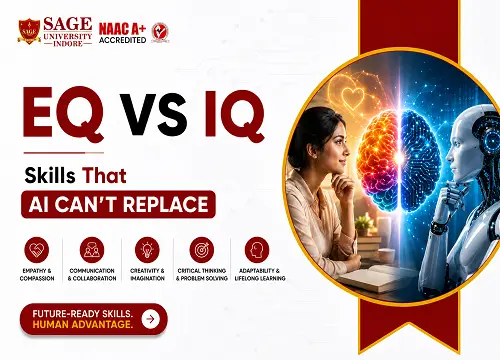
In today's AI-powered workplace, employers increasingly value emotional intelligence because many technical tasks can be automated, while empathy, leadership, adaptability, and human relationships remain uniquely human strengths.
What is IQ (Intelligence Quotient)?
IQ, or Intelligence Quotient, measures a person's cognitive abilities, including:
- Logical reasoning
- Mathematical ability
- Memory
- Pattern recognition
- Problem-solving
- Analytical thinking
A high IQ often helps students perform well academically and enables professionals to master technical knowledge quickly.
However, career success depends on much more than academic intelligence.
What is EQ (Emotional Quotient)?
Emotional Quotient (EQ), also known as Emotional Intelligence (EI), is the ability to recognize, understand, manage, and influence emotions—both your own and those of others.
People with high EQ tend to:
- Build stronger relationships
- Handle workplace stress effectively
- Communicate clearly
- Resolve conflicts professionally
- Inspire and motivate teams
- Adapt to change
These skills are increasingly important in modern organizations where teamwork and collaboration drive innovation.
EQ vs IQ: What's the Difference?
| IQ (Intelligence Quotient) | EQ (Emotional Quotient) |
|---|---|
| Measures analytical intelligence | Measures emotional intelligence |
| Focuses on reasoning and logic | Focuses on empathy and relationships |
| Helps in exams and technical tasks | Helps in teamwork and leadership |
| Supports learning new concepts | Supports collaboration and communication |
| Opens career opportunities | Accelerates career growth |
| Easier to automate through AI | Difficult for AI to replicate |
Why Emotional Intelligence Matters More in Today's Workplace
The workplace has changed dramatically over the past decade.
Organizations now seek professionals who can:
- Work effectively in diverse teams
- Adapt to rapid technological changes
- Communicate across departments
- Manage workplace stress
- Lead with empathy
- Solve conflicts constructively
As artificial intelligence automates routine and repetitive tasks, human-centered skills have become a competitive advantage.
Employers increasingly recognize that emotional intelligence contributes to higher productivity, stronger collaboration, and better leadership.
Five Core Components of Emotional Intelligence
1. Self-Awareness
Understanding your emotions, strengths, weaknesses, and behavioral patterns allows you to make thoughtful decisions and improve continuously.
2. Self-Regulation
Self-regulation is the ability to control emotional reactions, especially during challenging situations.
Professionals who remain calm under pressure often earn greater trust from colleagues and managers.
3. Motivation
Emotionally intelligent individuals remain focused on long-term goals rather than temporary setbacks.
They are internally driven to learn, improve, and contribute consistently.
4. Empathy
Empathy involves understanding another person's perspective and responding with compassion and respect.
This quality strengthens teamwork, customer relationships, and leadership effectiveness.
5. Social Skills
Strong interpersonal skills help professionals:
- Build trust
- Influence others positively
- Resolve disagreements
- Collaborate across teams
- Lead successful projects
A Real Workplace Example
Consider two software developers.
Ajay is technically exceptional but struggles to accept feedback. He often becomes defensive during code reviews and creates unnecessary tension within the team.
Vijay is also a capable developer. While he may not always produce the fastest solutions, he communicates openly, welcomes feedback, supports colleagues, and remains calm under pressure.
When leadership opportunities arise, organizations are more likely to promote Vijay because effective leadership depends on emotional intelligence as much as technical expertise.
Can Emotional Intelligence Be Developed?
Yes.
Unlike many people believe, emotional intelligence is not a fixed trait.
It can improve through consistent practice and self-reflection.
Research suggests that individuals who actively develop emotional intelligence become more effective communicators, leaders, and problem-solvers over time.
Practical Ways to Improve Your EQ
- Listen to Understand: Instead of preparing your response while someone else is speaking, focus on understanding their perspective.
- Pause Before Reacting: When emotions rise, pause for a few seconds before responding. This simple habit often leads to more thoughtful communication.
- Accept Constructive Feedback: Feedback is an opportunity for improvement rather than criticism. Reflect on it objectively and identify actionable lessons.
- Practice Empathy Daily: Before judging someone's actions, consider the circumstances they may be facing. Empathy builds stronger professional relationships.
- Strengthen Communication Skills: Clear, respectful communication reduces misunderstandings and improves teamwork.
EQ and Artificial Intelligence
Artificial intelligence continues to transform industries by automating repetitive tasks, analyzing large datasets, and improving operational efficiency.
However, AI cannot fully replace human capabilities such as:
- Building trust
- Understanding emotions
- Ethical decision-making
- Conflict resolution
- Coaching and mentoring
- Inspirational leadership
As organizations adopt AI, professionals with strong emotional intelligence are likely to become even more valuable.
The future belongs to individuals who combine technical expertise with exceptional human skills.
Key Takeaways
- IQ measures cognitive and analytical abilities.
- EQ measures emotional awareness and interpersonal skills.
- Both IQ and EQ contribute to career success.
- Emotional intelligence has become increasingly valuable in AI-driven workplaces.
- Leadership, collaboration, communication, and adaptability rely heavily on EQ.
- Emotional intelligence can be developed through consistent practice.
Frequently Asked Questions (FAQ)
IQ measures intellectual abilities such as reasoning, logic, and problem-solving, while EQ measures emotional awareness, empathy, communication, and relationship management.
Both are important. IQ helps you acquire technical knowledge and solve complex problems, while EQ enables effective teamwork, leadership, and long-term career growth.
Yes. Emotional intelligence can be strengthened through self-awareness, active listening, emotional regulation, empathy, and continuous feedback.
Organizations value emotional intelligence because emotionally intelligent employees collaborate effectively, adapt to change, resolve conflicts professionally, and contribute positively to workplace culture.
Technical skills help professionals enter a career, but emotional intelligence often determines leadership opportunities, promotions, and long-term success.
No. AI can automate analytical and repetitive tasks, but human qualities such as empathy, ethical judgment, trust-building, and emotional understanding remain difficult to replicate.
Conclusion
Academic excellence and technical expertise remain valuable in every profession. However, in today's fast-changing, AI-driven world, emotional intelligence has become a defining factor for sustainable career success.
Professionals who combine strong IQ with well-developed EQ are better equipped to lead teams, navigate uncertainty, build meaningful relationships, and thrive in the future of work.
Investing in emotional intelligence is no longer optional—it's one of the smartest career decisions you can make.